Identity, quantity and purity
A common bundle of tests requested at Erie Coast Analytical is identity, quantity and purity. What do those terms mean on your Certificate of Analysis?
Identity
Confirms that the peptide in the vial is the peptide the label claims. The test checks the peptide's molecular mass against the value expected from its amino acid sequence. It gives assurance that no manufacturing mix-up occurred: no mislabeling, no substituted compound, no vial missing its peptide entirely.
Identity is tested by liquid chromatography-mass spectrometry (LC-MS), matching the sample's measured mass-to-charge ratios (m/z) to the expected values.
Quantity
Determines the amount of target peptide in the vial, in milligrams. HPLC compares the sample's UV peak area to a calibration curve built from a certified reference standard. If your vial is labeled 10 mg, quantity tells you whether it holds 10 mg or some other amount.
Purity
Measures the percentage of target peptide relative to the other UV-absorbing peptide material in the sample, such as truncated sequences, deletion peptides, failed synthesis byproducts or degradation products.
High purity (e.g., over 98%) means nearly all of that detectable material is your desired peptide. It also reduces the risk of unwanted biological effects, immune reactions or experimental interference from contaminants.
Purity is calculated by comparing the target compound's peak area to the total area of all peaks in the HPLC chromatogram.
- Identity tells you what your sample is.
- Quantity tells you how much of it is there.
- Purity tells you how clean it is.
Quantity is often confused with net peptide content (NPC)
Be clear on what the quantity value (sometimes called "net content") on your COA tells you, and what it doesn't. HPLC typically uses a UV detector, which sees components by how they absorb UV light. Anything that doesn't absorb UV is effectively invisible to it.
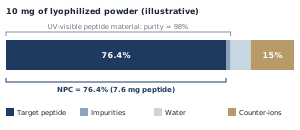
Net peptide content is the percentage of the lyophilized powder's total weight that is actually peptide. The rest is non-peptide material the UV detector can't see: moisture, counter-ions such as trifluoroacetate (TFA) or acetate, and residual solvents.
Because the gross powder weight includes all of these, measuring NPC accurately takes specialized methods.
Two ways to measure it
The two most common ways of measuring NPC are (1) amino acid analysis and (2) the mass balance approach.
Amino acid analysis (AAA)
AAA measures the absolute amount of peptide by taking the molecule apart and counting its building blocks. The sample is hydrolyzed: heated with acid (typically 6 N HCl at about 110 °C) to break every peptide bond.
The freed amino acids are chemically tagged to make them easier to detect, separated by HPLC, and each one is quantified against certified amino acid standards.
Mass balance approach
Mass balance calculates NPC by subtracting every measured non-peptide fraction (e.g., moisture and counter-ions) from the total weight, then adjusting for purity.
- Water: Karl Fischer (KF) titration measures the moisture trapped in the lyophilized cake.
- Counter-ions: measured directly by ion chromatography, or estimated stoichiometrically.
Stoichiometric estimation calculates the theoretical counter-ion fraction from the peptide's sequence, counting its basic sites (Lys, Arg, His and the free N-terminus) and multiplying by the known salt form. NPC can also be assigned by quantitative HPLC against a reference standard of the same peptide with a certified NPC.
Putting it together
NPC (%) = Purity (%) × [100% − Water (%) − Counter-ion (%)] ÷ 100As the equation shows, NPC is always lower than the HPLC purity value, because it excludes moisture and counter-ion content. Purity is often above 95%, while NPC commonly lands around 70 to 85%.
Where NPC matters
Dosing precision in in vivo research
In animal studies and clinical research, doses are calculated per kilogram of body weight based on the active ingredient. Confusing gross powder weight with net peptide weight leads to systematic underdosing, which skews pharmacokinetic and pharmacodynamic data.
Quantitative in vitro assays
In biochemical assays, exact molar concentration determines valid results. A researcher who assumes 100% NPC will make stock solutions weaker than planned, leading to experiments that can't be reproduced.
ECA Learn articles are educational material. They describe general analytical principles and are not a substitute for a validated method or a Certificate of Analysis.